


Traces of the City in the Anthropocene
The world has now become a fragile palimpsest,
composed of the traces left together by the human and the more-than-human.
Cities are both the producers and the carriers of these traces.
Ecological, social, political, and sensory processes
intersect here in their most concentrated form.
In the Anthropocene,
we read the city not as a completed form,
but as a multilayered formation
that is continuously written, erased, and reconstructed.
Every street,
every void,
every crack
carries the trace of a rupture, an encounter,
a possibility.
This call is directed toward making visible
the sediments of the past
on the palimpsest surface of layered cities,
and toward imagining futures that have not yet emerged.
The manifesto here is not merely a text.
It may be an action, an image, an object, an experience,
or a silent gesture.
Suspending the rigid frames between utopia and dystopia,
we invite the collective production of
open-ended, experimental, and plural urban imaginaries
emerging from multiple ecological relations.
Because the Palimpsest City
is not only the city of what has been,
but of what is becoming,
and of the futures that can be built together.
Event Manifesto
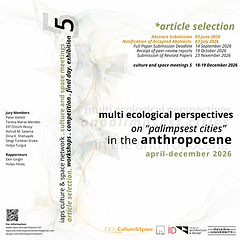


OZU – Faculty of Architecture and Design APRIL 2026 - DECEMBER 2026
________________________________________________________________________________________
IAPS-CS ‘Culture & Space’ Network: CULTURE & SPACE MEETINGS 5
ARTICLE SELECTION | WORKSHOPS | STUDENT COMPETITION | FINAL MEETING |
Presentations & Award Ceremony & Exhibition
________________________________________________________________________________________
MULTI-ECOLOGICAL PERSPECTIVES ON PALIMPSEST CITIES IN THE ANTHROPOCENE
________________________________________________________________________________________
IAPS – Culture and Space Network[1] - Culture and Space Meetings is an international platform that has been organized since 2012 with the aim of supporting formal architectural education through informal, interactive, and experiential activities. It brings together young architects and designers, researchers, academics, and students within a shared environment of dialogue and exchange. These meetings continue to generate new interdisciplinary discussions on Istanbul, a city characterized by its multilayered structure, dynamism, and ongoing transformation. In the meetings held to date, a range of themes have been addressed, including Istanbul’s urban memory, spatial continuity, practices of transformation, the spatiality of everyday life, and the city’s complex and multilayered urban fabric.
Istanbul, as a palimpsest city, sustains the persistent presence of historical traces while simultaneously accommodating superimposed, juxtaposed and interwoven layers that reshape its physical and conceptual fabric. In this sense, the city is approached not as a fixed and unified whole, but as a relational structure that can be interpreted through continuities and ruptures. Reading this multilayered urban fabric opens up discussions around concepts such as randomness, spontaneity, assemblability, and articulation, thereby offering new perspectives on how the city is produced and experienced (Turgut, 2018; 2021). In this context, the platform continues to foster perspectives that move beyond treating the city as a fixed entity, instead conceptualizing it as a relational field in which historical, social, cultural, and spatial processes are continuously reproduced.
The continuous evolution of world cities through the production of ever-new layers within complex networks of relations transforms the IAPS Culture and Space Meetings from a merely theoretical platform into a field of practice that engages with, interrogates, and reinterprets the city. Bringing together literary, visual, spatial, and experiential forms of production, this platform encourages the establishment of new conceptual linkages between the past, present, and future of the city. In this sense, the meetings reposition participants from passive observers to active subjects who interpret urban space through multiple sensory layers. The outcomes generated not only contribute to academic knowledge production but also foster critical spatial awareness and collective modes of thinking.
In the Anthropocene, the multilayered structure of cities can no longer be understood solely as a socio-cultural accumulation; rather, it calls for a new mode of spatial thinking that requires the combined reading of ecological and geological processes shaped by anthropogenic impacts. Within this context, the IAPS Culture & Space meetings aim to approach urban practices not only through a socio-spatial lens but also through a relational framework in which ecological, biophysical, and cultural layers are deeply intertwined. Bringing together literary, interactive, and experiential forms of production, the series offers participants opportunities to engage with both Istanbul and the other of palimpsest cities through multiple modes of reading and experience. Accordingly, ‘the fifth edition of the IAPS-CS Network Culture & Space Meetings’ will be convened under the theme “Multiple Ecological Perspectives on Palimpsest Cities in the Anthropocene”. Hosted by the OZU – Faculty of Architecture and Design, the comprises an interconnected sequence of activities—including an international article selection (English), student workshops (national, Turkish), a student idea competition (national, Turkish), and a final meeting day constitutes the culmination of the process, assembling selected papers, award-winning student projects, and the outcomes of workshops —extending from April 2026 to December 2026. This multi-stage structure aims to ensure continuity across works produced at different scales and through diverse modes of production, thereby strengthening the link between theoretical discussions and design- and experience-oriented practices.
[1]The IAPS-CS Network is a scientific organization independent of place and institution, operating within the framework of IAPS, the International Association for People–Environment Studies. In the fields of the built environment, design, and planning, it aims to identify problems arising from the interactions between culture and space; to establish the relationship between theory and practice; and to investigate solutions within an interdisciplinary framework. Alongside theoretical and applied studies, it also aims to address these issues within the architectural education process.
The Network also seeks to to build a communication network among researchers, organizes international and national scientific meetings and produces publications related to the subject. http://www.iaps-association.org
http://www.iapscultureandspace.net
MAIN THEME
MULTI-ECOLOGICAL PERSPECTIVES ON PALIMPSEST CITIES IN THE ANTHROPOCENE
We are witnessing a period unprecedented in the history of humanity and the world we inhabit: the Anthropocene. Described by scientists and environmental thinkers as “the end of the world as we know it” (McKibben, 2011), this era signifies a radical rupture in which human-induced impacts have irreversibly transformed the planet’s geological, biological, and climatic systems. The warming of the Earth due to the increase in atmospheric greenhouse gases, the rapid melting of polar ice caps, droughts, unexpected wildfires, the decline of biodiversity, and extraordinary ecological devastation are only a few manifestations of this transformation.
Within the Anthropocene, cities occupy a paradoxical position: they are both major drivers of these changes and highly vulnerable ecosystems directly affected by them. Human-induced environmental transformations not only alter urban forms and spatial organization but also deeply influence the everyday practices, collective memory, and emotional landscapes of urban inhabitants, who are themselves embedded within—and shaped by—these processes (OzelÇi, 2025). This approach aligns with contemporary theoretical readings of the Anthropocene that do not treat it solely as an anthropocentric geological epoch, but rather as a relational surface in which human and non-human actors collectively leave traces, and where material and temporal layers accumulate and can be read relationally (Latour, 2018; Haraway, 2016).
In recent years, disasters witnessed on a global scale—along with the destructive impacts of the climate crisis, wars, mass migrations, and pandemics—have tested both the position of urban dwellers and the capacities of cities to renew, repair, and reorganize themselves in different ways. Each new event inscribes fresh traces onto the layers of the city, while simultaneously causing certain past layers to be erased or transformed. These unexpected ruptures are already shaping the multiple possibilities of the future. As long-term global transformations intertwine with immediate and localized interventions, ecological, social, political, and cultural changes become most visibly concentrated within urban environments. Cities and urban fragments that are transformed or destroyed through wars, earthquakes, and the interventions of decision-making actors offer powerful readings of this multi-layered condition of rupture. These readings move away from approaches that treat cities as fixed and closed systems, instead conceptualizing them as open-ended processes in which continuities and ruptures, along with visible and erased traces, coexist (Ingold, 2011; DeLanda, 2006). In this context, world cities persist as palimpsest structures—interconnected within an organic networked system, multilayered, and continuously rewritten. While tracing the remnants of layers that are fading or have already been erased, we simultaneously attempt to read the signs of what is “yet to come” and to consider how potential new layers might emerge. Within this conceptual framework, the “yet to come” is not treated as a fixed goal or scenario determined by linear projections, but rather as a field of speculative, cultural, and plural possibilities emerging from the tensions between existing layers.
From this perspective, the main focus of IAPS – C&s Network – Culture and Space Meetings 5 is shaped by the necessity of developing a multi-ecologies perspective when discussing the future of cities. Within this framework, the aim is to establish a new relationality between the multilayered structure of palimpsest cities and an understanding of ecological plurality.
A multi-ecologies perspective approaches cities not merely as environmental systems, but as dynamic formations in which social relations, subjective experiences, and interspecies encounters are co-produced. Félix Guattari conceptualizes ecology through the mutual interaction of environmental, social, and mental/subjective registers, emphasizing that urban space is a field of production that is not only physical, but also political, cultural, and sensorial (Guattari, 1989)[1]. Anna Lowenhaupt Tsing, in turn, understands ecologies as fragile, temporary, and plural networks of encounters established by human and more-than-human actors within historical, economic, and technological processes. This perspective enables urban ecosystems to be read not as static structures, but through uncertainty, conflict, and processes of becoming-with (Tsing, 2015)[2]. These approaches also resonate with contemporary theoretical frameworks that refuse to reduce ecology solely to the natural environment, instead conceptualizing it through relational networks among human and non-human beings, technological infrastructures, and political processes. Bruno Latour challenges the modern division between nature and society, framing cities as hybrid and political ecological networks shaped through the collective agency of human and non-human actors (Latour, 2004; 2018)[3]. Timothy Morton, meanwhile, proposes thinking ecological processes through “hyperobjects” that exceed human perception in terms of temporal and spatial scales, defining ecology not as a singular or balanced system but as a multiplicity of fragile and ongoing relational entanglements (Morton, 2007; 2013)[4]. Within this framework, a multi-ecologies perspective makes it possible to read palimpsest cities beyond historical layering alone, as dynamic formations in which interspecies, technological, temporal, and political interactions are deeply intertwined.
Unexpected paradigm shifts are overturning established notions of time, space, norms, and order, making new narratives of the future unavoidable. As the classical distinctions between utopia and dystopia become blurred, heterotopic realities are increasingly normalized in everyday life. This situation allows for a rethinking of Foucault’s concept of heterotopia in the context of contemporary ecological and technological ruptures, positioning the city both as a space of crises and as a field for experimenting with alternative ways of living (Foucault, 1986; Brenner, 2019).In this context, emerging urban layers point not only to physical transformations but also to utopian–dystopian palimpsest formations encompassing intellectual, emotional, technological, and ecological dimensions. These intermediate forms make it possible to approach the future not as a singular and closed imagination, but as open-ended and negotiable urban configurations in which multiple possibilities can coexist simultaneously (Ozorhon et al., 2025).
This thematic framework invites participants to reflect on future imaginaries shaped by the entanglement of changing ecosystems, fragile geologies, multispecies encounters, socio-political transformations, and technological processes. Under the influence of the Anthropocene, cities are no longer merely lived spaces; they have become intersectional fields of environmental, ecological, technological, and social transformations. In this context, the IAPS Culture and Space Meetings 2025 Series, under the title “Multiple Ecological Perspectives on Palimpsest Cities in the Anthropocene” aims to open up discussion on new ways of thinking about the future of cities. Participants are expected to bring critical issues—such as urban transformation, continuity, and fragility—into discussion through productions in the form of texts, actions, objects, spaces, images, or experiences. The event offers an open-ended, experimental, and multidisciplinary platform that moves beyond utopian or dystopian classifications. Young designers, students, and researchers are invited to build new bridges between Istanbul’s past, present, and future, and to develop critical, creative, and relational urban imaginaries.
DISCUSSION QUESTIONS
-
In the Anthropocene, how does humanity’s determining influence over the planet transform the relationship between cities and nature? Does the city remain a construct positioned against nature, or is it evolving into a living, adaptive organism engaged in continuous negotiation with natural systems?
-
Through which social, political, economic, and ecological processes are the traces and layers accumulated by cities over time preserved, erased, or rewritten over time?
-
In palimpsest cities, how do conflicts, overlaps, and discontinuities between layers enable multiple ecological readings that move urban space beyond anthropocentric and material representations in the Anthropocene?
-
When the city is approached as a text, which lines of this text do we read in the Anthropocene, which do we rewrite, and which do we consciously or unconsciously choose to overlook?
-
When envisioning the future of palimpsest cities, with which concepts, images, narratives, and affective registers do we begin to write
-
In an era of accelerating time and increasingly elastic, can urban memory sustain continuity, or does permanent fragility, rupture, and impermanence prevail?
-
How do human-induced crises—such as climate change, war, migration, pandemics, and other global disruptions—radically redefine urban existence?
-
In what ways do crises, decision-making mechanisms, technological infrastructures, and social ruptures transform urban palimpsests, and what possible future scenarios do these transformations render visible?
-
Can an environment of poly_crises also make visible the cities’ capacities for self-repair, adaptation, and resilience?
-
In a geography of crises and ruptures, how can palimpsest cities generate new forms of urban co-existence between destruction and continuity?
-
Through which spatial, affective, or speculative tools can “not-yet-realized possibilities” be rendered visible at the urban scale?
-
How can palimpsest cities such as Istanbul be rethought, within the Anthropocene, as distinctive laboratories for reading multiple ecological ruptures and possible futures?
[1] Félix Guattari defines ecology not as a concept limited to the natural environment, but as a multilayered process constituted through the reciprocal interactions of environmental, social, and mental/subjective dimensions. This perspective understands urban space as a field in which political, cultural, and sensory productions are deeply intertwined, thereby imparting an ethical and critical dimension to ecological thought.
[2] Anna Lowenhaupt Tsing approaches ecologies as fragile, provisional, and interdependent networks of relations formed by human and non-human actors within historical, economic, and technological processes. By focusing on interspecies encounters, this perspective conceptualizes ecological systems not as stable structures but as plural, indeterminate, and conflictual processes.
[3] Bruno Latour Bruno Latour addresses ecological issues through relational networks jointly composed by human and non-human actors, rejecting the modern dichotomy between nature and society. Within his approach to political ecology, cities are defined as hybrid formations in which technical, spatial, cultural, and ecological processes intersect.
[4] Timothy Morton Timothy Morton addresses ecological phenomena through the concept of “hyperobjects,” which exceed human perception in terms of temporal and spatial scales. This approach conceptualizes ecology not as a closed and balanced system, but as a set of plural processes that generate uncertainty, entanglement, and continuity.
KEYWORDS
Urban Palimpsest, Palimpsest cities, Anthropocene, multiple ecologies, poly-crises, ecological and social disruptions, layers, relationality, ruptures, tension, conflict, urban memory, continuity, temporality, resilience, vulnerability, metamorphosis, future imaginaries, scenarios, Istanbul, alternative urban readings.
GENERAL PARTICIPATION REQUIREMENTS
The events are open to undergraduate, master’s, and doctoral students—either individually or as teams—from relevant departments of Faculties of Architecture and Design (such as Architecture, Interior Architecture, Urban and Regional Planning, Landscape Architecture, Industrial Design, Communication Design, Graphic Design, etc.). Teams may be formed with an interdisciplinary structure by including members or advisors from other social sciences and humanities disciplines, such as psychology and sociology.
Scientific Steering Committee*
Didem Boyacıoğlu; Ozyegin University, Faculty of Architecture and Design, Türkiye
Peter Kellett; Newcastle University, School of Architecture, United Kingdom; IAPS–CS Network
Güliz Özorhon; Ozyegin University, Faculty of Architecture and Design, Türkiye; Urban & Housing Lab ‘OZU-UHL’
Ashraf M. Salama; Northumbria University at Newcastle, School of Architecture, United Kingdom; IAPS Education Network
Dina K. Shehayeb; Nile University, Giza, Egypt
Hülya Turgut; Ozyegin University, Faculty of Architecture and Design, Türkiye; IAPS–C&S Network; Urban & Housing Lab ‘OZU-UHL’; Scientific Convenor
Giulio Verdini; University of Westminster, School of Architecture + Cities, United Kingdom
* In alphabetical order
Organizing Committee
Hülya Turgut, Ozyegin University, Faculty of Architecture and Design
Güliz Özorhon, Ozyegin University, Faculty of Architecture and Design
Didem Boyacıoğlu, Ozyegin University, Faculty of Architecture and Design
Ekin Girgin, Halic University, Faculty of Architecture
Hülya Yavaş, Ozyegin University, Faculty of Architecture and Design
Eda Kış, Ozyegin University, Faculty of Architecture and Design
Beril Özelçi, Ozyegin University, Faculty of Architecture and Design

ARTICLE AWARD 5:
MULTI-ECOLOGICAL PERSPECTIVES ON PALIMPSEST CITIES IN THE ANTHROPOCENE
____________________________________________________________________
Announcement: 13 April 2026
Abstract Submission Deadline (Updated!): 3 June 2026
Notification of Accepted Abstracts (Updated!): 3 July 2026
Full Paper Submission Deadline: 14 September 2026
Receipt of peer-review reports: 19 October 2026
Submission of Revised Papers: 23 November 2026
Final Meeting Day : 18-19 December 2026
____________________________________________________________________
Within the scope of the article selection, contributions are expected to critically, conceptually, and theoretically engage with the overarching thematic framework of “Multiple Ecological Perspectives on Palimpsest Cities in the Anthropocene,” focusing on the multi-layered, fragile, and dynamic nature of urban environments.. In this regard, theoretical readings, critical comparisons, conceptual modelings, as well as experimental applications drawing from critical urban theory, ecological thought, memory studies, speculative design, futures studies, and relational spatial approaches constitute key components of the selection. The aim is to establish a comprehensive intellectual framework that approaches urban space not merely as a physical settlement, but as a complex formation where historical, ecological, and social processes are deeply intertwined.
In the Anthropocene, cities are being reshaped by planetary-scale ecological transformations, climate-related uncertainties, and socio-environmental disruptions. This condition challenges established assumptions of urban stability, continuity, and linear progress. Within this context, cities are increasingly understood as palimpsestic formations in which accumulated historical layers intersect with contemporary ecological crises and future imaginaries that remain open, contingent, and subject to negotiation. Accordingly, the city emerges as a layered construct that carries traces of the past, confronts the multiplicity of present crises, and simultaneously accommodates divergent potential futures.
The primary aim of this call is to reconsider palimpsest cities through a future-oriented lens and to develop new theoretical and methodological approaches at the intersection of space, time, memory, transformation and futurity. In this respect, the Anthropocene is understood not only as an era of environmental crisis, but also as a temporal and epistemic threshold that transforms the production of urban knowledge and spatial imaginaries.
Contributions are expected to critically examine how Anthropocene dynamics—such as climate change, environmental degradation, resource depletion, and multispecies entanglements—reconfigure urban temporalities and spatialities. Furthermore, submissions are encouraged to develop critical problematizations of possible urban futures and to propose alternative scenarios that expand the horizon of urban thinking.
Authors are expected to construct conceptual continuities between the past, present, and possible futures of palimpsest cities; to build an interdisciplinary and critical field of inquiry; and to propose innovative urban imaginaries and theoretical frameworks. Submitted works should be grounded in a robust theoretical foundation, include systematic critical analysis, and develop original conceptual and/or methodological contributions that deepen the understanding of urban transformation under Anthropocene conditions.
All submissions will be evaluated through a double-blind peer-review process conducted by the Editorial/Selection Committee. Selected articles are intended to be published in an internationally indexed journal. In addition, it is envisaged that selected works will be included in a collective volume at the national level alongside other outputs of the event, and in an international edited book as part of the broader series of selected papers.
All submissions will be evaluated through a double-blind peer review process conducted by the Selection Committee. The selected article will be encouraged to be published in an internationally indexed journal; additionally, together with the other outputs of the event they are planned to be published in a national book, and together with other selected papers from the series in an international book.
Article Award Jury *
Peter Kellett; Newcastle University, School of Architecture, United Kingdom; IAPS–CS Network
Teresa Marat-Mendes; ISCTE, School of Technology and Architecture, Portugal
Elif Öztürk Aksoy; Architectural Researcher, PhD, (Award-winning article author, IAPS–CS Network Activities 4, 2018–2019)
Ashraf M. Salama; Northumbria University, School of Architecture, Newcastle, United Kingdom; IAPS Education Network
Dina K. Shehayeb; Nile University, Giza, Egypt
Sevgi Türkkan Sroka; Istanbul Technical University Faculty of Architecture, Istanbul, Türkiye
Hülya Turgut; Ozyegin University, Faculty of Architecture and Design, Türkiye;
IAPS–C&S Network, Urban & Housing Lab ‘OZU-UHL’
* In alphabetical order
Rapporteurs
Hülya Yavaş, Ozyegin University, Faculty of Architecture and Design; Ph.D student, ITU
Ekin Girgin, Halic University, Faculty of Architecture; Ph.D student, ITU
Participation Requirements
The selection is organized as an article competition open to doctoral candidates who have completed their PhD theses within the last five years or who are currently pursuing their doctoral research, and whose work is related to the overall theme of the event series.
Papers must be original and single-authored.
-
Originality: Papers must be original, single-authored, and previously unpublished. A similarity check will be conducted. The paper must not be under review in another journal.
-
Use of artificial intelligence: Artificial intelligence tools must be used responsibly and transparently. AI should not replace human contribution but should support it. Content generated or modified by AI must be clearly disclosed. The name and version of the AI tool used must be specified. The use of generative AI for text production (writing, content generation) is not permitted. However, AI may be used for language correction, editorial assistance, and text improvement.
Award-winning participants are expected to present their papers on the final day of the 5th IAPS-CS Culture and Space Meetings, to be held on 18–19 December 2026. Participants from abroad may deliver their presentations online. Selected papers will be prepared for publication by the authors.
Important Notes
Participants are required to submit a one-page short CV and their abstracts in English by 25 May 2026, by completing the online form. A 1000-word abstract, including the title of the paper and summarizing its aims, methodology/approach, and findings with references, must be submitted. Five keywords should be carefully selected to represent the research. Author names must not be included on this page.
The language of the papers is English, and they must be single-authored.
Papers must be submitted in accordance with the specified formatting guidelines, including original figures and tables, in both Word (.doc) and PDF formats, to the editorial office of the Paper Selection Committee at iapscultureandspacenetwork@gmail.com.
Submitted papers will not be returned to the authors. Authors’ names, addresses, institutional affiliations, titles, telephone numbers, and email addresses must be included in the cover letter. All submissions will undergo a double-blind peer-review process, with author identities concealed.
Formatting Guidelines
-
Papers must not exceed 8,000 words. This limit includes the abstract, references, all text in tables, figures, and appendices.
-
Paper title _Page 1: The first page should include a concise, clear, and sufficiently informative title.
-
Author information_Page 2: The second page must include the author’s full name (to be published in full), email address (preferably institutional), and institutional affiliation (the institution to which the author was affiliated during the research period).
-
Notes_Endnotes: Footnotes or endnotes should be used only when strictly necessary. They should be indicated in the text using sequential numbers in square brackets. These numbers must then be listed and explained at the end of the paper.
-
References: In-text citations and the reference list must be formatted according to the Harvard referencing style.

DESIGN WORKSHOP 5
ISTANBUL AS A PALIMPSEST CITY IN THE ANTHROPOCENE:
REIMAGINING URBAN FUTURES
____________________________________________________________________
@ Hybrid
Announcement: 13 April 2026
Announcement of Workshop Topics: 2 June 2026
Application Deadline for participants: 15 June 2026
Announcement of Accepted Applications: 06 July 2026
Workshop / Hybrid: September-October 2026
Exhibition Delivery: 02 November 2026
Final Meeting & Exhibition: 18-19 December 2026
_________________________________________________________
Within the framework of the main theme, “Multi-Ecological Perspectives on Palimpsest Cities in the Anthropocene,” the IAPS-CS Network Culture and Space Design Workshop 5 invites participants to produce experiential works that focus on Istanbul and the imagination of its future through diverse modes of representation. The workshops are organized as hybrid studios that combine online and in-person sessions.This workshop invites participants on an intuitive and critical intellectual journey that moves between traces of the past, ruptures of the present, and possibilities of the future. It approaches Istanbul in the context of the Anthropocene not merely as a site of crisis, but as a spatial text that is read, erased, layered, and continuously rewritten. In this sense, the idea of the “city in the Anthropocene” is framed not only as a condition of crisis, but also as an act of rethinking and rewriting. Participants are expected to draw on urban experiences to produce new languages, images, and imaginaries appropriate to this epoch.The workshop is open to undergraduate and graduate students, as well as interdisciplinary participants, from architecture, urban studies, design, art, and the social sciences. Participants are invited to develop new questions and possibilities concerning the future of the city in the Anthropocene through critical thinking, intuitive production, and experimental modes of representation.
Invited Workshop Instructors*
-
İpek Avanoğlu & Elif Adıgüzel & Bahar Avanoğlu
-
İdil Erdemir Kocagil & Mehmet Emin Bayraktar
-
Ekin Girgin & Burak Çıkırıkçı
-
Arzu İl Varol & Ebru Yetkin
-
Gökçe Ketizmen & Eşref Taner İlerde
-
Gülbin Lekesiz & Can Müezzinoğlu
-
Ayşe Okudan
-
Eda Şarman Ergün
-
Ali Kemal Terlemez & Orkan Güzelci
* In alphabetical order
Coordinator
Didem Boyacıoğlu, Özyeğin Üniversitesi, Mimarlık ve Tasarım Fakültesi
Rapporteurs
Hülya Yavaş, Özyeğin Üniversitesi, Mimarlık ve Tasarım Fakültesi
Eda Kış, Özyeğin Üniversitesi, Mimarlık ve Tasarım Fakültesi
Beril Özelçi, Özyeğin Üniversitesi, Mimarlık ve Tasarım Fakültesi

STUDENT COMPETITION 5:
MULTI-ECOLOGICAL PERSPECTIVES ON ISTANBUL AS A PALIMPSEST CITY IN THE ANTHROPOCENE:
Future Imaginaries, and Emerging Narratives
____________________________________________________________________
Announcement of the Competition:13 April 2026
Deadline for Questions 11 May 2026
Announcement of Responses: 18 May 2026
Deadline for Registration: 15 June 2026
Submission Deadline: 05 October 2026
Jury Meeting: 06 October 2026
Announcement of Results: 16 November 2026
Final Gathering & Exhibition: 18-19 December 2026
____________________________________________________________________
This competition invites students to propose bold and experimental ideas that challenge dominant urban narratives while foregrounding multiple ecologies, speculative futures, and alternative modes of storytelling. How might Istanbul be reimagined if it is read not as a fixed or completed city, but as an Anthropocene palimpsest—a terrain shaped by erasures, residues, ruptures, and emergent possibilities?
Participants are encouraged to work with radical imaginaries, hybrid representations, and critical design strategies that question how cities are inhabited, remembered, and transformed under conditions of ecological uncertainty.
Submissions may take the form of spatial proposals, visual narratives, speculative scenarios, or experimental mappings that open up new ways of thinking about Istanbul’s possible futures.
Jury Members
Nagehan Açimuz İşbakan, Özyeğin Üniversitesi, Mimarlık ve Tasarım Fakültesi
Gül Çanakçıoğlu, Özyeğin Üniversitesi, Mimarlık ve Tasarım Fakültesi
Aslıhan Demirtaş, KHORA Tasarım ve Araştırma Ofisi
Boğaçhan Dündaralp, DDRLP Mimarlık
Güliz Özorhon, Özyeğin Üniversitesi, Mimarlık ve Tasarım Fakültesi
Hıfsiye Pulhan, Eastern Mediterranean University, Faculty of Architecture
Hülya Turgut, Özyeğin Üniversitesi, Mimarlık ve Tasarım Fakültesi
Rapporteurs
Hülya Yavaş, Özyeğin Üniversitesi, Mimarlık ve Tasarım Fakültesi
Eda Kış, Özyeğin Üniversitesi, Mimarlık ve Tasarım Fakültesi
Competition Participation Conditions
-
The competition is open to undergraduate and graduate students studying in departments such as Architecture, Interior Architecture, Urban and Regional Planning, Landscape Architecture, Industrial Design, Communication Design, Graphic Design, and related fields.
-
Teams may collaborate with students from disciplines such as psychology, sociology, philosophy, fine arts, cinema and television, photography, or work with an academic advisor.
-
The formation of interdisciplinary teams is strongly encouraged.
-
Applicants interested in participating in the competition are required to complete the online application form by 15 July 2026.

FINAL MEETING DAY 5
____________________________________________________________________
Presentations & Award Ceremony & Exhibition:
18-19 December 2026
____________________________________________________________________
As the fifth edition of the IAPS–CS Network Culture & Space Student Meetings, previously held in 2012, 2014, 2016, and 2018–2019. This event will be organized as an academic platform where the outcomes of the related works will be exhibited, awards will be presented, and selected articles will be delivered.
Note:
The final outputs of all works will be compiled into a printed book.Award-winning papers will be published in English.
In addition, all workshops, exhibitions, and productions carried out within the scope of the event will be archived in a printed book and simultaneously made accessible through a digital platform.
REFERENCES
-
Brenner, N. (2019). New urban spaces: Urban theory and the scale question. New York, NY: Oxford University Press.
-
DeLanda, M. (2006). A new philosophy of society: Assemblage theory and social complexity. London: Bloomsbury Academic.
-
Foucault, M. (1986). Of other spaces (J. Miskowiec, Trans.). Diacritics, 16 (1), 22–27. https://doi.org/10.2307/464648
-
Guattari, F. (2000). The three ecologies (I. Pindar & P. Sutton, Trans.). London: The Athlone Press.
-
Haraway, D. J. (2016). Staying with the trouble: Making kin in the Chthulucene. Durham, NC: Duke University Press.
-
Ingold, T. (2011). Being alive: Essays on movement, knowledge and description. London: Routledge.
-
Latour, B. (2004). Politics of nature: How to bring the sciences into democracy (C. Porter, Trans.). Cambridge: Harvard University Press.
-
Latour, B. (2018). Down to earth: Politics in the new climatic regime (C. Porter, Trans.). Cambridge: Polity Press.
-
McKibben, B. (2011). Eaarth: Making a life on a tough new planet. New York, NY: St. Martin’s Griffin.
-
Morton, T. (2007). Ecology without nature: Rethinking environmental aesthetics. Cambridge: Harvard University Press.
-
Morton, T. (2013). Hyperobjects: Philosophy and ecology after the end of the world. Minneapolis, MN: University of Minnesota Press. http://www.jstor.org/stable/10.5749/j.ctt4cggm7
-
Özelçi, B. (2025). Antroposen tartışma zeminleri bağlamında alternatif bir kent belleği okuması: Dolapdere, İstanbul [An alternative reading of urban memory in the context of Anthropocene debates: Dolapdere, Istanbul] (Unpublished master’s thesis). Özyeğin University, City and Architecture Master's Program, Istanbul.
-
Özorhon, G., Keskin, Ö., & Kış, E. N. (2025). İstanbul’un amfibi halleri ve gelecek spekülasyonları [Istanbul’s amphibian states and future speculations]. In F. Umaroğulları, D. Atik, & A. Akyıldız (Eds.), XIV International Sinan Symposium: Architecture and Future – Proceedings (Vol. 1, pp. 371–380). Edirne: Trakya University. https://sinansymposium-en.trakya.edu.tr/pages/proceeding-e-books (in Turkish)
-
Tsing, A. L. (2015). The mushroom at the end of the world: On the possibility of life in capitalist ruins. Princeton, NJ: Princeton University Press.
-
Turgut, H. (2021). Istanbul: The city as an urban palimpsest. Cities, 112(2), 103131. https://doi.org/10.1016/j.cities.2021.103131
SUGGESTED READING
-
Aksoy, E. Ö., & Çebi, P. D. (2024). A conceptual exploration of hidden spatial layers: Reading urban-breccia. Sustainability, 16(4), 1625. https://doi.org/10.3390/su16041625
-
Bauer, U. M., Kanwar, A., & Teh, D. (Curators). (2022, September 17 - November 20). 17th Istanbul Biennial [Exhibition]. İstanbul Kültür Sanat Vakfı, Istanbul, Türkiye.
-
Bottà, G. (2012). Berlin as urban palimpsest. In A. Choné (Ed.), Villes invisibles et écritures de la modernité. Paris: Ôrizons.
-
Bourriaud, N. (Curator). (2019, September 14 - November 10). The Seventh Continent: 16th Istanbul Biennial [Exhibition]. İstanbul Kültür Sanat Vakfı, Istanbul, Türkiye.
-
Bourriaud, N. (2019). Theses on art in the age of global warming. In N. Bourriaud (Ed.), The Seventh Continent: 16th Istanbul Biennial Field Report (pp. 20–42). Istanbul: İstanbul Kültür Sanat Vakfı.
-
Burry, J., & White, M. (Eds.). (2023). Urban dystopias: Lofty ideals to shocking realities. Oxford, England: John Wiley & Sons.
-
Corboz, A. (1983). The land as palimpsest. Diogenes, 31(121), 12–34. https://doi.org/10.1177/039219218303112102
-
Crutzen, P. J. (2002). Geology of mankind. Nature, 415(6867), 23. https://doi.org/10.1038/415023a
-
Crutzen, P. J., Stoermer, E. F., & Steffen, W. (2013). The “Anthropocene.” In L. Robin, S. Sörlin, & P. Warde (Eds.), The future of nature: Documents of global change (pp. 483–490). New Haven, CT: Yale University Press. https://doi.org/10.2307/j.ctt5vm5bn.52
-
Çaylı, E. (2020). İklimin estetiği: Antroposen sanatı ve mimarlığı üzerine denemeler. Istanbul: Everest Yayınları. (in Turkish)
-
Çinçik, B., & Torres-Campos, T. (Eds.). (2021). Postcards from the Anthropocene. Barcelona: dpr-barcelona.
-
Dillon, S. (2007). The palimpsest: Literature, criticism, theory. London: Bloomsbury Publishing.
-
Dunne, A., & Raby, F. (2013). Speculative everything: Design, fiction, and social dreaming. Cambridge, MA: MIT Press.
-
Foucault, M. (2001). The order of things: An archaeology of the human sciences. London: Routledge.
-
Gordin, M. D., Tilley, H., & Prakash, G. (Eds.). (2010). Utopia/dystopia: Conditions of historical possibility. Princeton, NJ: Princeton University Press.
-
Gürbüz, E. (2013). Jeolojik imzamız: Antroposen. Bilim ve Teknik, 46(546), 74–77. (in Turkish)
-
Huyssen, A. (2003). Present pasts: Urban palimpsests and the politics of memory. Stanford, CA: Stanford University Press.
-
Jon, I. (2021). Cities in the Anthropocene: New ecology and urban politics. London: Pluto Press.
-
Kajdanek, K., Bednarczyk, A., & Carvalho, R. (Eds.). (2025). Crisis, conflict and celebration: Ethnographic studies of European cities. London: Palgrave Macmillan.
-
Machin, A., & Wissenburg, M. (Eds.). (2025). Handbook of environmental political theory in the Anthropocene. Cheltenham: Edward Elgar Publishing.
-
MacLeod, G., & Ward, K. (2002). Spaces of utopia and dystopia: Landscaping the contemporary city. Geografiska Annaler: Series B, Human Geography, 84(3–4), 153–170. [Special issue: The dialectics of utopia and dystopia]. https://www.jstor.org/stable/3554313
-
Marzluff, J. M., Shulenberger, E., Endlicher, W., Alberti, M., Bradley, G., Ryan, C., Simon, U., & ZumBrunnen, C. (Eds.). (2008). Urban ecology: An international perspective on the interaction between humans and nature. New York, NY: Springer. https://doi.org/10.1007/978-0-387-73412-5
-
Morton, T. (2013). Hyperobjects: Philosophy and ecology after the end of the world. Minneapolis, MN: University of Minnesota Press. http://www.jstor.org/stable/10.5749/j.ctt4cggm7
-
Nora, P. (2022). Hafıza mekânları [Les lieux de mémoire] (M. E. Özcan, Trans.). Ankara: Doğu Batı Yayınları. (in Turkish)
-
Şen, M., Hamzaçebi, E., & Kutup, S. (2019). Disiplinlerarası ekolojik-etik karşılaşmalar: Çoğalan ve yayılan bir aradalıklar. Cogito, (95–96), 241–253. (in Turkish)
-
Tan, D., & Nguyen, M. Q. (2024). Beyond the palimpsest: Traditions and modernity in urban villages of Shenzhen, China. Cities, 151, 105093. https://doi.org/10.1016/j.cities.2024.105093
-
Tyszczuk, R. (2019). Provisional cities: Cautionary tales for the Anthropocene. London: Routledge.
-
Yates, F. A. (2001). The art of memory. Chicago, IL: University of Chicago Press.
-
Žižek, S. (2012). Antroposen’e hoşgeldiniz [Welcome to the Anthropocene] (M. Budak, Trans.). Istanbul: Encore Yayınları. (in Turkish)
CULTURE AND SPACE NETWORK MEETINGS PUBLICATION SERIES
* Publications comprising selected papers produced within the scope of the IAPS-CS Meetings
-
Almaç, B., Gümrü, B., Günöz, Ö., Şen, İ., Şoher, Ş., & Turgut, H. (2013). Bir “palimpsest” kent olarak İstanbul ve kusurluluk: Bir tasarım atölyesi ve öğrenci yarışması. Arredamento Mimarlık, (9), 98–103. Istanbul: Boyut Yayıncılık. (in Turkish)
-
Turgut, H. (Ed.). (2013). Istanbul as a palimpsest city and imperfection [Special issue]. A|Z ITU Journal of the Faculty of Architecture, 10(1). Istanbul: Istanbul Technical University, Faculty of Architecture. https://www.az.itu.edu.tr/jfa/issue/view/34 / IAPS-CS 1
-
Turgut, H., & Atıcı, M. (2015). İstanbul’u düşlemek: Bir ulusal öğrenci yarışması deneyimi ve değerlendirmesi. YAPI, (406), 76–89. Istanbul: Yem Yayın. (in Turkish)
-
Turgut, H., & Cantürk, E. (2015). Design workshops as a tool for informal architectural design education. Open House International, 40(2), 88–95. Bradford: Emerald Publishing. https://doi.org/10.1108/OHI-02-2015-B0012
-
Turgut, H., & Çelikcan, C. (2015). Bir “palimpsest” kent olarak İstanbul’da gelecek artık eskisi gibi değil. YAPI, (404), 66–75. Istanbul: Yem Yayın. (in Turkish)
-
Turgut, H., & Akbalık, E. (2017). Dosya: Bir palimpsest kent olarak İstanbul’da gelecek artık eskisi gibi değil. H. Turgut & E. Akbalık (Eds.), Mimarlık, (393), 40–57. Ankara: TMMOB Mimarlar Odası. (in Turkish) / IAPS-CS 2
-
Hacıhasanoğlu, O., Turgut, H., & Bayazitoğlu, Ü. C. (Eds.). (2018). Memory, traces and city: Şişli-Bomonti IAPS-CS Network culture and space design workshop. Istanbul: Özyeğin University Press.
-
Turgut, H. (2018). Culture and space workshops as an “informal” activity in architectural design education: Istanbul as a “palimpsest” city. In O. Hacıhasanoğlu, H. Turgut, & Ü. C. Bayazitoğlu (Eds.), Memory, traces and city: Şişli-Bomonti IAPS-CS Network culture and space design workshop (pp. 8–17). Istanbul: Özyeğin University Press.
-
Turgut, H. (Ed.). (2018). Reading Istanbul as a palimpsest city [Special issue]. A|Z ITU Journal of the Faculty of Architecture, 15(2). Istanbul: Istanbul Technical University, Faculty of Architecture. https://www.az.itu.edu.tr/jfa/issue/view/15 / IAPS-CS 3
-
Turgut, H. (2018). Dossier editorial: Reading Istanbul as a ‘palimpsest’ city. A|Z ITU Journal of the Faculty of Architecture, 15(2), 1–3. Istanbul: Istanbul Technical University, Faculty of Architecture. https://www.az.itu.edu.tr/jfa/issue/view/15
-
Turgut, H., Mutman Uluengin, D., & Çanakçıoğlu, N. G. (Eds.). (2022). Sonsuz bir “kentsel artikülasyon” mekânı olarak İstanbul. Istanbul: Özyeğin University Press. https://yayinevi.ozyegin.edu.tr/tr/kitaplar/sonsuz-bir-kentsel-artikulasyon-mekani-olarak-istanbul-iaps-cs-4 (in Turkish) / IAPS-CS 4
HOST INSTUTIONS


AWARD INSTITUTIONS


MEDIA SPONSORS


